


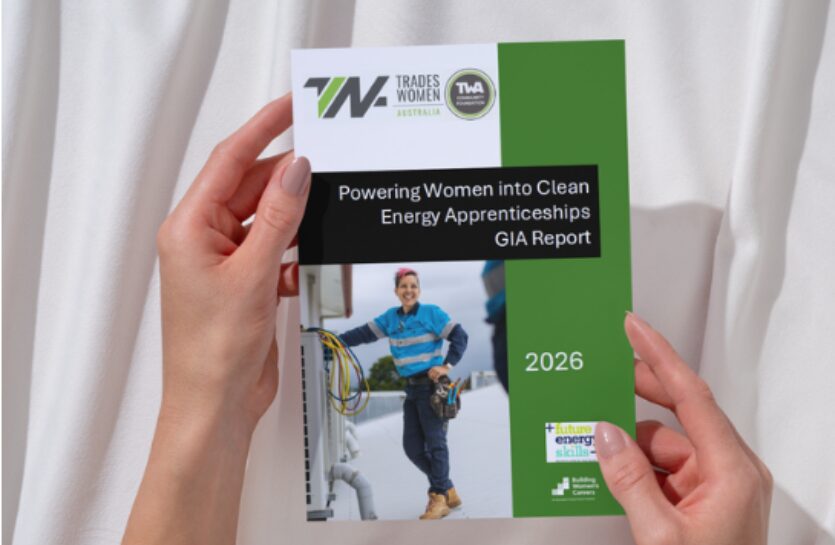
A new Gender Impact Assessment Report (GIA) produced by Tradeswomen Australia highlights the persistent structural and cultural barriers preventing women from entering and completing electrical apprenticeships in Australia, at a time when the sector urgently needs a larger and more diverse workforce.
Developed as part of the Powering Women into Clean Energy Apprenticeships Project, the report draws on Tradeswomen Australia’s expertise supporting women in trades and centres the lived experiences of women working in the electrical industry. The findings make clear that increasing women’s participation in electrical trades is not only an equity issue, but a critical response to Australia’s growing clean energy skills shortages.
The project, led by Future Energy Skills, brings together organisations across the clean energy, electrotechnology, apprenticeship and training sectors to address workforce shortages by removing barriers and improving pathways for women into electrical apprenticeships.
From Research to Action
Commissioned by Future Energy Skills and produced by Tradeswomen Australia, the GIA report represents the first phase of the Powering Women into Clean Energy Apprenticeships Project. The report involved research into the lived experiences of women in the electrical industry, identifying the structural and cultural factors that limit participation and retention.
The report includes:
- A rapid literature review
- Interview findings with women and mentors in the electrical trades
- A practical toolkit of policies and resources designed to help employers create safer, more inclusive workplaces
One interview participant, Juniper*, an A-grade electrician, described the day-to-day pressures faced by women on site:
“[They think] you only got that because you’re a girl. It cheapens what you’ve worked for… all these little things that people say and do just add to that pressure to be better, be perfect.”
Persistent Barriers Remain
Despite modest increases in female participation over the past decade, women remain significantly under-represented in Australia’s electrical trades at less than 4% of the workforce.
Drawing on both research and lived experience, Tradeswomen Australia identified several well-established barriers, including:
- Rigid gender norms within the electrical sector
- Limited awareness of training pathways and career opportunities
- Recruitment and advertising practices that exclude women
- Toxic or unsafe workplace cultures
- A lack of coordinated, sector-wide efforts to improve conditions for women in the industry
Another interviewee, Charles*, a mentor within the electrical sector, noted the broader cultural challenges:
“If they’re against women in their trades, they’ll be against gay people… trans people… non-white people. It’s not just changing sexist culture — it’s changing entire world views.”
A Call to Action for Industry
The report emphasises that the causes of women’s under-representation in the electrical industry are already well documented. The challenge now is action.
By reframing the issue from ‘why women don’t choose electrical trades’ to ‘how the industry can remove barriers and improve conditions’, the Powering Women into Clean Energy Apprenticeships project aims to support lasting change across the sector.
The Gender Impact Assessment Report is now available for download here.
About the Project
The Powering Women into Clean Energy Apprenticeships project, led by Future Energy Skills, aims to address clean energy skill shortages through supporting employers with female apprentices to identify and address specific systemic and cultural barriers to women’s participation in the electrical industry.
The project focuses on addressing clean energy skill shortages by designing and testing more equitable apprenticeship models that enhance workplace culture and safety.
Expanding the talent pool and diversifying the electrical workforce is essential for sustainability and to meet the forecast required growth of the electrical industry.
*Name has been changed to protect privacy
The Building Women’s Careers (BWC) Program is funded by the Australian Government Department of Employment and Workplace Relations.